Work Order Process Improvement That Sticks

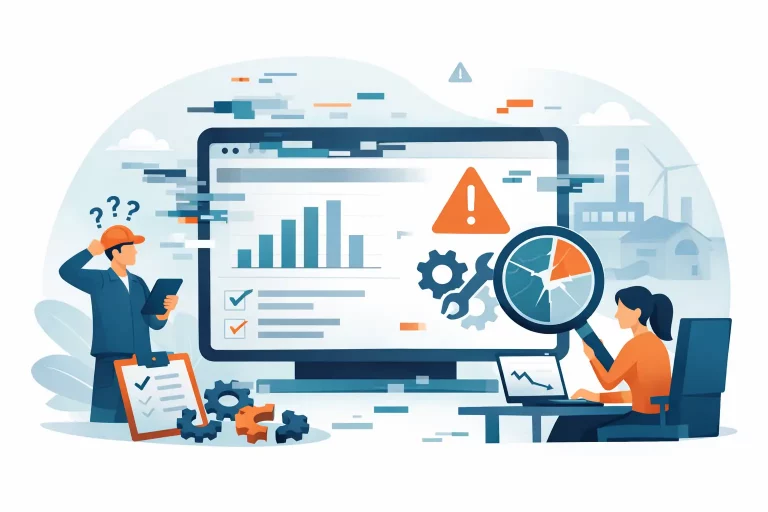
A work order should move work forward. Too often, it does the opposite. It sits in a queue without the right priority, reaches a technician missing critical details, gets closed with weak completion notes, and leaves leadership with bad data and no clear view of performance. That is why work order process improvement matters. It is not about making tickets look cleaner in a system. It is about building a process that drives execution, accountability, and better operational decisions.
For maintenance teams and field service organizations, this problem usually does not start with the software. It starts with a workflow that was never fully designed. The CMMS or FSM becomes a storage location for requests instead of a control point for labor, asset history, service response, and reporting. Once that happens, every downstream issue gets harder to solve. Dispatch struggles to prioritize, technicians work around the system, planners fill in gaps manually, and leadership loses trust in the data.
What work order process improvement actually means
In practical terms, work order process improvement means redesigning how work is requested, approved, planned, assigned, executed, documented, and closed. Each stage needs clear rules, usable data, and the right level of control. If one stage breaks down, the entire chain becomes unreliable.
A common example is request intake. Many organizations allow anyone to submit anything with little structure. The result is predictable: vague problem descriptions, duplicate requests, poor asset tagging, and no consistent way to distinguish a true priority event from routine work. Teams then spend labor sorting noise instead of managing operations.
Another common issue is technician execution. If your technicians receive work orders with inconsistent instructions, missing parts information, no estimated labor expectations, or weak failure coding requirements, you are not running a process. You are relying on individual experience to compensate for system weakness. That may work with your best technicians. It does not scale across sites, shifts, or new hires.
Why most work order workflows break down
The biggest reason is that organizations confuse system use with process control. They believe that because work orders exist in the platform, the process is functioning. But a system can capture activity without improving it.
In struggling environments, work orders often have too many statuses or not enough. Approval rules are unclear. Preventive and corrective work flow through the same path even when they require different handling. Dispatch teams reprioritize by email or phone because the queue cannot be trusted. Supervisors close old work in batches to clean backlog metrics, which destroys reporting accuracy.
There is also a governance problem. Many organizations never define who owns the work order lifecycle. Operations owns urgency, maintenance owns execution, planners own scheduling, and leadership wants reporting, but no one owns the end-to-end standard. That is where inconsistency grows. Site by site, manager by manager, the process drifts.
The operational cost of a weak process
Poor work order management is not just an administrative issue. It affects uptime, labor efficiency, customer response, and cost control.
When requests enter the system with weak information, technicians lose time diagnosing basics that should have been captured up front. When prioritization is inconsistent, urgent work competes with routine tasks and planned maintenance gets pushed aside. When close-out documentation is poor, reliability teams cannot identify repeat failures or make informed asset decisions. When data fields are optional or loosely used, reporting becomes a debate instead of a management tool.
This is why many organizations feel busy but not in control. The team is moving, but the process is not producing visibility. Leaders see backlog numbers, completion counts, and response times, yet still cannot answer simple questions about wrench time, repeat visits, preventive maintenance compliance, or failure trends with confidence.
Where to focus first in work order process improvement
The right starting point is not always the same. It depends on whether your biggest pain is request chaos, planning delays, field execution inconsistency, or poor reporting. But in most environments, five areas create the biggest lift.
1. Standardize request intake
Every work order begins with the quality of the request. If requestors can submit incomplete or inconsistent information, the rest of the process inherits that weakness. Required fields should reflect what operations actually needs to triage the work: asset or location, issue type, business impact, contact details, and enough description to classify the task correctly.
This does not mean making submission so complicated that users avoid it. The trade-off is real. Too few fields create ambiguity. Too many create workarounds. The right design captures what is operationally necessary and removes everything else.
2. Tighten prioritization logic
Priority should not be based on who complains the loudest or which supervisor calls first. It should follow a defined model tied to safety, asset criticality, service impact, regulatory risk, and operational consequence. If priorities are vague, your schedule becomes reactive by default.
This is also where many teams need clearer separation between emergency, urgent, routine, and planned work. Without that structure, preventive maintenance gets interrupted constantly, and the organization slowly trains itself into permanent firefighting.
3. Improve technician-ready work orders
A technician-ready work order includes the information needed to execute the job correctly and document it consistently. That may include asset history, task instructions, parts references, safety steps, labor expectations, failure coding, and close-out requirements.
The exact level of detail depends on the work type. A simple corrective task in a stable facility may need less planning than a regulated asset repair, a field service dispatch, or a multi-trade event. The point is not to over-engineer every ticket. The point is to stop sending avoidable ambiguity into the field.
4. Fix status design and closure discipline
Status design should reflect real operational stages, not vague labels that mean different things to different people. Submitted, approved, planned, scheduled, in progress, waiting on parts, completed, and closed may be enough for one organization. Another may need more nuance for dispatch, customer coordination, or subcontractor activity.
What matters is that each status has a clear definition, ownership, and reporting purpose. Closure is especially important. If completion notes, cause codes, downtime entries, and parts usage are inconsistent, the system cannot support planning, reliability analysis, or KPI reporting.
5. Build reporting around behavior, not just volume
Many dashboards focus on open versus closed work orders, average response time, and backlog counts. Those metrics matter, but they rarely expose why the process is underperforming. Better reporting looks at request quality, schedule compliance, aging by status, repeat repairs, technician close-out completeness, PM conversion rates, and backlog by priority and craft.
Strong reporting changes behavior when it makes process failures visible. If one site has excellent closure rates but poor failure coding, you know where coaching is needed. If another has strong request intake but excessive waiting-on-parts time, the bottleneck is different.
Improvement fails when adoption is ignored
Even a well-designed workflow will fail if the field sees it as extra admin. That is why implementation matters as much as design. People adopt processes when the process helps them do the job with less confusion, fewer callbacks, and better support from supervisors and dispatch.
This is where many software projects fall short. The system gets configured, but nobody translates the workflow into daily execution standards. Technicians are trained on screens, not on decision logic. Supervisors are told to enforce the process, but they are not given clear expectations or usable exception reports. The result is predictable: partial adoption, inconsistent data, and a quick return to manual side channels.
Effective work order process improvement usually requires more than a settings change. It requires role clarity, workflow governance, targeted training, and follow-up metrics that reinforce the new standard.
What better looks like
A mature work order process is not necessarily complicated. It is consistent. Requests enter the system with usable information. Priorities reflect real business impact. Planned work is protected from avoidable disruption. Technicians receive clear instructions and close work with meaningful documentation. Managers review exception-based reporting instead of chasing basic status updates.
That kind of operating model creates compound value. Data becomes more reliable. Scheduling improves. Repeat failures become easier to identify. Preventive maintenance performance becomes measurable. Leadership gains a clearer view of where labor is going and where process friction is draining it.
For organizations trying to scale across multiple sites or service regions, that consistency becomes even more important. Without it, every location develops its own version of the truth. With it, the platform becomes a management system instead of a digital filing cabinet.
Eficiqo sees this often: teams do not need more tickets in the system. They need a process that turns work orders into controlled execution and usable operational intelligence.
The real test of process improvement is simple. If your work orders still depend on phone calls, tribal knowledge, and supervisor cleanup to produce results, the process is not doing its job yet. Fix that, and the system starts supporting performance instead of creating more noise.