In House Versus Outsourced Maintenance

When a chiller fails at 2:00 a.m. or a production asset goes down in the middle of a peak shift, the debate around in house versus outsourced maintenance stops being theoretical. It becomes a question of response time, accountability, data quality, labor capacity, and whether your operating model can actually support uptime.
For maintenance leaders and operations executives, this decision is rarely about picking a side. It is about choosing the structure that gives your organization the best control over execution, the clearest visibility into performance, and the strongest return on labor and vendor spend. In many cases, the right answer is not fully internal or fully outsourced. It is a disciplined model built around asset criticality, technician capability, service coverage needs, and the maturity of your operating systems.
Why in house versus outsourced maintenance is really an operating model decision
Too many organizations treat this as a staffing decision. It is not. It is an operating model decision that affects workflow design, preventive maintenance compliance, work order quality, inventory planning, dispatch coordination, and reporting credibility.
An internal team can give you tighter control over priorities, stronger familiarity with assets, and closer alignment with site leadership. But if that team is understaffed, poorly scheduled, or working from inconsistent CMMS processes, the benefits disappear quickly. You end up with reactive work, delayed PMs, and technicians spending more time chasing information than completing jobs.
Outsourcing can solve capacity gaps and provide specialized expertise faster than hiring. It can also create distance between the work being done and the data your leadership team needs to manage performance. If contractors are not documenting work consistently, updating labor accurately, or following standardized workflows, outsourced maintenance becomes expensive activity without operational visibility.
That is why the real question is not which option sounds better. The real question is which model your organization can govern effectively.
Where in-house maintenance usually performs best
In-house maintenance tends to work well when uptime depends on rapid response, intimate asset knowledge, and strong day-to-day coordination with operations. Manufacturing plants, healthcare facilities, campuses, and complex multi-building environments often benefit from internal teams because priorities shift constantly and local context matters.
An internal team usually has better awareness of recurring failure patterns, operator behaviors, site constraints, and temporary workarounds that never make it into manuals. That knowledge matters. It shortens troubleshooting time, improves communication with production or facility leadership, and supports better judgment when the situation is messy.
There is also an accountability advantage. Internal technicians are part of the organization’s culture, reporting structure, and performance expectations. If the maintenance manager runs a disciplined planning process, uses the CMMS correctly, and tracks compliance and backlog health, in-house teams can become a major source of operational control.
But there is a catch. Internal maintenance only outperforms outsourcing when it is actually managed as a system. If scheduling is weak, preventive maintenance is incomplete, and labor reporting is inconsistent, bringing work in house does not create control. It just moves the dysfunction onto payroll.
Common strengths of in-house teams
Internal teams typically bring faster response for priority work, stronger institutional knowledge, and better collaboration with site stakeholders. They are also better positioned to support standardized preventive maintenance routines when the organization has clear procedures and supervisory discipline.
Common failure points
The most common problems are skill gaps, overtime dependency, poor planner-scheduler discipline, and overreliance on a few senior technicians who carry too much tribal knowledge. When those conditions exist, internal maintenance can look cheaper on paper while quietly creating backlog growth, repeat failures, and reporting blind spots.
Where outsourced maintenance makes sense
Outsourced maintenance can be the right move when your needs are variable, geographically dispersed, highly specialized, or difficult to staff internally. Multi-site service networks, retail portfolios, distributed facilities, and organizations with niche equipment often use contractors because the labor model is more flexible and the recruiting burden is lower.
This model can also work well when you need access to specialized certifications or technical depth that is unrealistic to build internally. Think controls work, advanced HVAC diagnostics, elevators, medical equipment support, or OEM-specific service. In those cases, outsourcing is not a compromise. It is a practical decision based on capability.
Outsourcing can also help organizations stabilize operations during transition periods. If vacancies are high, workloads are backlogged, or a preventive maintenance program has fallen apart, a strong contractor network can create breathing room while leadership rebuilds structure.
The risk is that many organizations outsource execution without building vendor governance. Work gets completed, but not in a way that supports planning, financial visibility, or long-term asset strategy. You see invoices, but not reliable failure data. You get service coverage, but not consistent root cause documentation. The result is a service model that feels active while staying operationally opaque.
Cost is not the first metric to evaluate
Most organizations start with labor cost comparisons. That is understandable, but it is usually the wrong first lens.
The better starting point is total operating impact. What does delayed response cost your business? What is the financial effect of poor PM compliance? How much money is tied up in repeat failures, emergency vendor dispatches, overtime, or assets being replaced earlier than necessary because maintenance execution is inconsistent?
In-house maintenance has fixed costs: wages, benefits, tools, supervision, training, and coverage planning. Outsourced maintenance often looks variable and easier to control, but rates rise quickly when service is reactive, after-hours, poorly scoped, or spread across too many vendors. Both models become expensive when workflows are weak.
The strongest evaluation looks at labor utilization, first-time fix performance, PM completion, asset downtime, invoice accuracy, work order quality, and reporting trust. If your data cannot support those conversations, the problem is larger than staffing structure.
The role of CMMS and workflow discipline
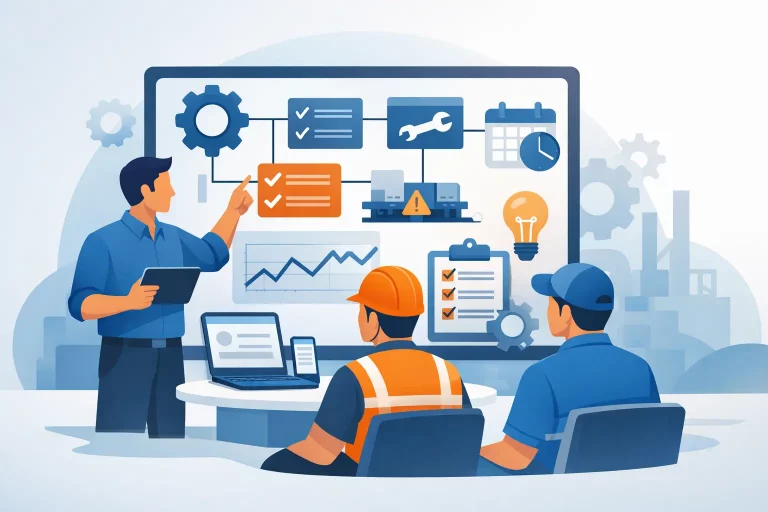
This is where many maintenance models break down. The success of in house versus outsourced maintenance often depends less on who performs the work and more on whether the work is executed through a controlled system.
If work orders are vague, statuses mean different things across sites, labor is not captured consistently, and asset data is incomplete, leadership cannot manage performance. Internal teams become hard to coach, and outsourced providers become hard to hold accountable.
A disciplined CMMS or FSM environment changes that. Standard work order types, clean asset hierarchies, required closeout fields, PM procedures, technician accountability, and meaningful KPI reporting create the structure needed to compare models fairly. Without that structure, every decision gets distorted by bad data and anecdotal opinions.
This is especially true in hybrid environments, where internal teams handle daily operations and contractors support overflow or specialized work. Hybrid models can be highly effective, but only if both groups operate inside the same workflow standards, service expectations, and reporting rules.
When a hybrid model is the best answer
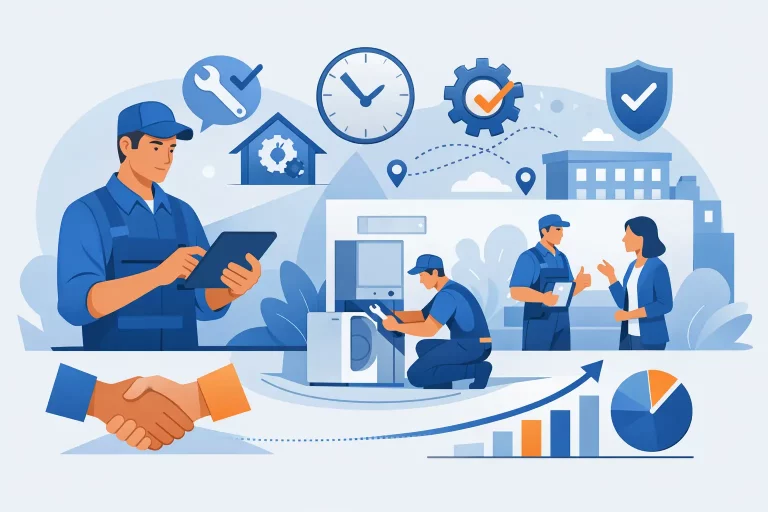
For many organizations, hybrid is the most practical path. Keep critical response, asset ownership, and operational coordination in house. Outsource specialized trades, peak-demand work, remote site support, or project-based maintenance where internal staffing is inefficient.
That approach gives you better control without forcing your team to carry every skill set or every labor fluctuation. It also reduces the all-or-nothing thinking that causes many maintenance organizations to make the wrong structural bet.
A hybrid model works best when roles are clearly divided. Internal teams should own what requires site knowledge, rapid coordination, and direct accountability to operations. Outsourced partners should be used where expertise, geographic reach, or labor flexibility matter more than daily organizational integration.
The key is governance. Someone has to own vendor performance, workflow compliance, scope clarity, and data quality. If no one does, hybrid becomes a loose collection of labor sources rather than an operating model.
How to make the right decision
Start with asset criticality and service expectations. If failure consequences are high and response windows are tight, internal ownership usually deserves strong consideration. Then assess labor capacity, technical depth, site coverage, and hiring realities. If your organization cannot recruit or retain the needed skill base, the in-house model may look better than it performs.
Next, evaluate system maturity. Can your CMMS support standardized planning, work execution, and reporting across whoever performs the work? If not, fix that before assuming one labor model will solve deeper process problems.
Finally, measure what leadership actually needs to manage. If you cannot see backlog by priority, PM compliance by asset class, contractor performance by vendor, or labor utilization by site, your decision will rely too heavily on assumptions.
This is where a firm like Eficiqo can add value – not by pushing outsourcing or insourcing as a default answer, but by helping organizations design the workflows, reporting structure, and execution standards that make either model perform.
The best maintenance model is the one your organization can execute with discipline, measure with confidence, and improve over time. If the structure gives you uptime, accountability, and usable data, you are on the right path. If it gives you activity without visibility, the model needs work before the next breakdown makes the decision for you.