
How to Standardize Asset Criticality
When two sites give the same air handler two different criticality scores, the problem is not the asset. The problem is the operating model. If you are trying to figure out how to standardize asset criticality, you are usually dealing with a deeper issue – inconsistent maintenance decisions, uneven PM coverage, weak reporting, and too much reliance on tribal knowledge.
Asset criticality should not be a side exercise buried in a spreadsheet. It should drive how your team plans work, assigns labor, prioritizes failures, builds PM programs, and explains maintenance risk to leadership. If the scoring method changes by site, by supervisor, or by whoever loaded the asset record years ago, the data will never support consistent action.
Why standardizing asset criticality matters
Most organizations already have some version of criticality. The issue is that it often means different things to different people. One facility manager may score based on replacement cost. Another may focus on safety exposure. A planner may think in terms of downtime. Finance may care most about service interruption. All of those factors matter, but when each group uses its own logic, the result is noise.
That noise creates operational consequences. Preventive maintenance frequencies become inconsistent. Spare parts strategy becomes reactive. Work order prioritization gets distorted. Capital planning lacks a clear risk basis. Reporting loses credibility because leadership cannot tell whether a “critical” asset in one building is truly comparable to a “critical” asset in another.
Standardization fixes that by creating one scoring method, one data structure, and one decision framework. It does not eliminate judgment. It gives judgment boundaries.
How to standardize asset criticality without making it academic
The biggest mistake is building a model that looks good in a workshop and fails in daily operations. A useful standard has to be simple enough for broad adoption and strong enough to support planning, reporting, and reliability decisions.
Start by defining what criticality is meant to influence in your organization. If the answer is vague, the scoring model will be vague too. In most maintenance and field service environments, asset criticality should affect PM strategy, response expectations, work order priority logic, parts stocking, escalation workflows, and asset replacement planning. If your model does not connect to those decisions, teams will not maintain it.
Next, separate asset criticality from work order priority. Those are related, but they are not the same. A highly critical asset can have a low-priority cosmetic issue. A lower-criticality asset can generate an urgent work order if it creates an immediate safety or compliance risk. When organizations blend those concepts together, the CMMS starts producing inconsistent signals.
Build a scoring model people can actually use
A practical model usually works best with a limited number of criteria and a clear scoring scale. In most environments, four to six scoring factors are enough. More than that tends to create false precision and slow adoption.
The most common scoring categories are business impact, safety or compliance risk, operational dependency, customer or occupant impact, redundancy, and maintenance recovery difficulty. The exact mix depends on your environment. A hospital, manufacturer, university, and commercial service contractor should not force the same weighting model if their risk profile is different.
That said, the structure should still be standardized enterprise-wide. If you operate across multiple sites, use one common framework and allow only limited, intentional adjustments by business unit when justified. The goal is comparability.
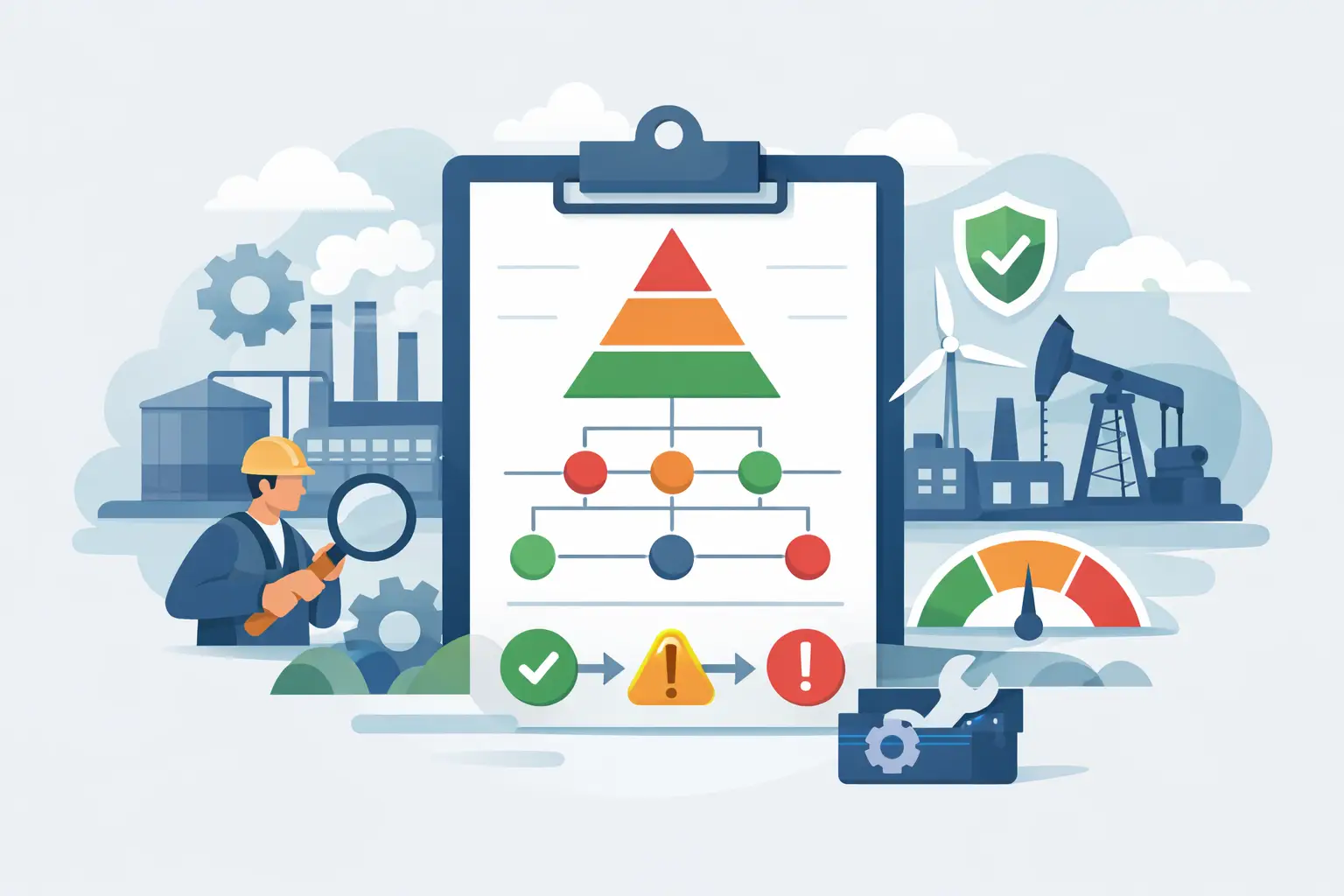
For example, you might assign each asset a score from 1 to 5 across four factors, then roll that into a total score mapped to criticality bands such as Critical, High, Medium, and Low. What matters most is not the math. What matters is that every scorer uses the same definitions.
A score of 5 for business impact cannot mean “major downtime” at one site and “slight inconvenience” at another. Define each level in plain operating language. Use examples. If needed, include thresholds such as production loss, patient care disruption, classroom closure, tenant impact, or SLA breach exposure.
Standard definitions matter more than perfect formulas
Organizations often spend too much time debating weighted formulas and not enough time on scoring discipline. A simple model with strong definitions will outperform a sophisticated model with weak governance.
This is where calibration matters. Before rolling the model out, take a sample set of assets from different facilities, asset classes, and operational contexts. Have multiple stakeholders score the same assets independently. Then compare results. The gaps will show you where definitions are unclear, where assumptions differ, and where training is needed.
You are not looking for theoretical agreement. You are looking for operational consistency. If ten people score a backup generator and scores range from low to critical, your model is not ready.
Tie asset criticality to asset class standards
One reason criticality programs fail is that every asset gets evaluated from scratch. That approach is slow, subjective, and hard to scale. A better approach is to define baseline criticality logic by asset class, then allow exceptions with documented justification.
For example, not every exhaust fan has the same criticality, but many will share similar risk characteristics within a given environment. The same applies to pumps, RTUs, switchgear, imaging equipment, conveyors, and compressors. Asset class standards create speed and consistency, especially during data cleanup, onboarding, and acquisitions.
This does not mean all assets in a class get the same score. It means the scoring process starts from a standard operational assumption. Teams then adjust for redundancy, location, service impact, or regulatory exposure.
That balance matters. If you standardize too aggressively, you miss real operational differences. If you allow too much discretion, you are back to opinion-based maintenance planning.
Your CMMS has to support the model
If the scoring framework lives in a slide deck but not in the CMMS, it will not hold. Asset criticality should exist as a controlled field with defined values, governance rules, and reporting visibility. If possible, the system should also store the underlying scoring rationale, not just the final label.
That helps in two ways. First, it improves trust. Second, it makes future reviews easier when conditions change. An asset may become more critical because occupancy increased, production shifted, compliance rules changed, or redundant equipment was removed.
CMMS design matters here. If users can type freeform criticality labels such as “high,” “very high,” “important,” or “priority 1,” your reporting is already compromised. Standardized dropdown values, role-based edit rights, and documented review workflows are basic controls, not optional nice-to-haves.
Governance is what keeps criticality from drifting
Once the model is built, the real work starts. Standardization breaks down when nobody owns the process. Asset criticality should have an accountable owner, typically within maintenance leadership, reliability, asset management, or operational systems administration.
That owner should define when criticality can be changed, who can approve changes, and what triggers a review. Common triggers include new asset installation, major failure events, changes in occupancy or production, compliance updates, and capital project turnover.
Annual review is useful, but event-based review is usually more effective. Criticality should change when operations change, not just when the calendar says so.
This is also where cross-functional input matters. Maintenance should not score in isolation if the asset directly affects clinical operations, production throughput, customer commitments, or regulatory exposure. The right stakeholders should inform the standard, but they should not create parallel versions of it.
How to standardize asset criticality across multiple sites
Multi-site organizations usually face the same pattern: one or two locations have a mature process, the rest have local variations, and corporate reporting tries to blend them into one dashboard. That creates misleading comparisons.
The fix is not forcing every site into the exact same operational context. The fix is standardizing the method, definitions, and governance while allowing controlled local inputs where they are genuinely necessary.
In practice, that means creating a master scoring framework, publishing examples by asset class, training site leaders on how to apply it, and validating results through periodic audits. It also means cleaning the existing asset data. If equipment hierarchies, naming conventions, and class structures are inconsistent, criticality standardization will stall because the asset foundation is unstable.
This is one reason many organizations pair criticality standardization with broader CMMS optimization. Eficiqo often sees criticality issues tied to larger workflow and data governance gaps, not just scoring methodology.
What good looks like
A standardized asset criticality model should make planning easier, not harder. Planners should know which assets need deeper PM strategy. Supervisors should know when to escalate. Leadership should be able to compare risk across facilities with confidence. Reliability teams should be able to focus analysis where failure matters most.
You will still have edge cases. You will still have debates. That is normal. The goal is not to eliminate every gray area. The goal is to stop running a maintenance program where the meaning of “critical” changes every time the conversation changes.
If you want asset criticality to improve uptime, labor efficiency, and reporting quality, treat it as an operating standard, not a scoring exercise. Once the logic is clear, the workflow disciplined, and the system controlled, the data starts supporting the decisions your team has been trying to make all along.
The strongest criticality model is the one your organization can actually sustain – across sites, across leaders, and under real operating pressure.