CMMS Versus EAM Software: Which Fits?

If your team is debating cmms versus eam software, the real question usually is not software at all. It is whether your operation needs a better maintenance execution system, or a broader asset management framework that reaches finance, procurement, compliance, and capital planning.
That distinction matters because many organizations buy for the wrong problem. A maintenance team struggling with PM completion, poor work order discipline, and weak technician adoption does not need a bigger platform just because it sounds more strategic. On the other hand, a multi-site operation trying to connect asset lifecycle cost, risk, inventory, contractor management, and long-range replacement planning may outgrow a CMMS faster than expected.
CMMS versus EAM software: the core difference
A CMMS is built first to manage maintenance work. Its center of gravity is the work order, the technician, the asset record, the PM schedule, and the labor and parts tied to execution. If your daily pain is reactive volume, missed preventive maintenance, poor backlog visibility, or inconsistent technician closeout, a CMMS typically addresses the operational layer directly.
An EAM system includes maintenance, but it usually extends further into asset lifecycle governance. That can include procurement workflows, depreciation data, warranty tracking, capital planning, compliance documentation, inventory strategy, and in some cases broader enterprise integration across finance, operations, and supply chain.
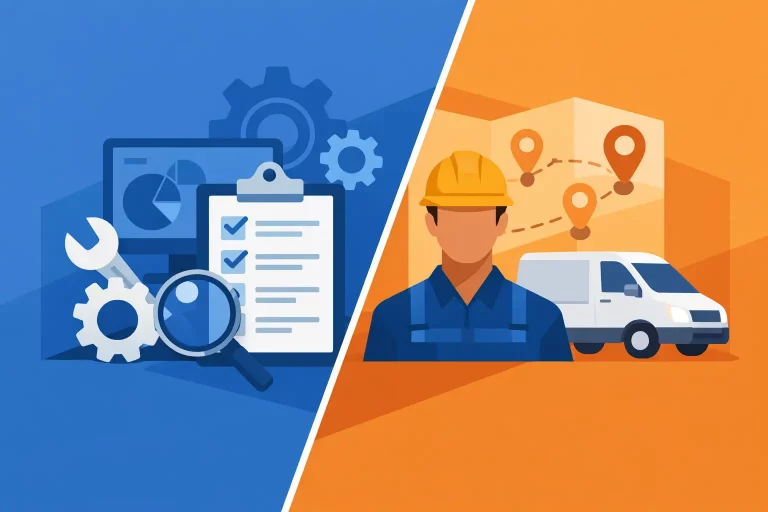
In plain terms, CMMS helps teams do maintenance better. EAM helps organizations manage assets as a business system.
That does not mean EAM is automatically better. It means the scope is different, and wider scope brings more complexity. More modules, more stakeholders, more required data discipline, and more process decisions tend to come with it.
Where CMMS makes the most sense
A CMMS is often the right fit when maintenance execution is the bottleneck. That is common in facilities, commercial service environments, healthcare engineering departments, education campuses, and many field-heavy service operations where teams need to standardize response, PM compliance, labor tracking, and asset history.
If technicians are still working from texts, paper, tribal knowledge, or loosely managed dispatch queues, a CMMS can create immediate structure. It can improve how work is requested, prioritized, assigned, completed, and reported. That alone can raise wrench time, tighten response windows, and give leadership a clearer view of backlog and asset performance.
This is especially true when the organization is still trying to get the basics under control. If your asset hierarchy is messy, PM templates are inconsistent, completion notes are weak, and reporting is unreliable, an EAM rollout can become an expensive way to digitize disorder. In that situation, a focused CMMS strategy usually creates faster value.
CMMS is also the better choice when the buying team is mostly operational. If the decision sits with maintenance leadership, facilities, or service operations, and the expected outcomes are uptime, technician accountability, and cleaner reporting, a CMMS is often aligned with what the business actually needs now.
Where EAM software earns its value
EAM software makes more sense when maintenance is only one part of a larger asset management strategy. This is more common in asset-intensive organizations with high compliance pressure, complex capital planning, large spare parts environments, and multiple business units that need shared visibility.
Manufacturing groups, aviation-related operations, utilities, public infrastructure teams, and large healthcare networks often move in this direction because they need more than maintenance scheduling. They need traceability across the asset lifecycle, from acquisition through operation to replacement. They may also need stronger connections between maintenance activity and financial decisions.
For example, if leadership wants to know whether an aging asset should be repaired, rebuilt, or replaced based on total cost, downtime history, warranty status, and risk exposure, that leans toward EAM. If procurement, finance, operations, and maintenance all need to work from the same asset framework, EAM becomes more relevant.
The trade-off is implementation burden. EAM projects often fail not because the software is weak, but because the organization is not ready for the operating model required to support it. Broader capability only helps when asset standards, workflows, ownership, and reporting expectations are clearly defined.
The mistake buyers make in cmms versus eam software decisions
The most common mistake is buying based on feature volume instead of operational maturity. Teams sit through demos, compare long requirement lists, and assume the platform with more capability is the safer long-term choice. In practice, unused capability creates clutter, weaker adoption, and more administrative overhead.
Another mistake is assuming CMMS is for smaller companies and EAM is for larger ones. Size matters less than complexity. A mid-market business with distributed assets, regulated environments, and capital-intensive operations may need EAM. A large enterprise with fragmented maintenance execution may still get better results from a well-structured CMMS approach first.
There is also a process problem hidden inside many software selections. Organizations try to solve workflow confusion with software terminology. They ask whether they need CMMS or EAM before they have clarified how work should enter the system, who owns planning, how technicians should close work, what KPIs matter, and how asset data will be governed. That sequence usually leads to disappointment.
What to evaluate before you choose
Start with the operational problem, not the software category. If the business needs better maintenance planning and execution, focus there. If it needs enterprise asset governance across departments, say that clearly.
Then look at asset criticality and lifecycle complexity. If assets are expensive, regulated, and tied to long-term capital decisions, EAM may be justified. If the immediate business impact comes from daily maintenance performance, CMMS is usually the cleaner path.
Next, assess process maturity. Can your team enforce standard work order statuses, failure codes, completion notes, labor capture, and PM procedures? If not, adding broader enterprise functionality will not fix the basics. It often magnifies inconsistency.
You should also evaluate reporting expectations. A lot of teams say they need EAM when what they actually need is better KPI structure inside a CMMS. If leadership cannot currently trust PM compliance, backlog aging, response time, schedule adherence, and asset downtime reporting, start there. Decision quality improves when execution data improves.
Finally, consider who must use the system every day. The best platform on paper will still fail if technicians find it cumbersome, planners bypass it, or supervisors cannot extract meaningful operational insight from it. Adoption is not a training issue alone. It is a workflow design issue.
The software matters less than the operating model
This is where many projects go off track. A CMMS with poor process design becomes a ticket inbox. An EAM with weak ownership becomes a giant database with low trust and low usage.
What drives performance is the operating model around the platform. That includes request intake rules, prioritization logic, planning standards, preventive maintenance structure, mobile execution expectations, data governance, reporting cadence, and management accountability. Without those elements, the platform category matters far less than vendors would like you to believe.
That is also why organizations sometimes feel underwhelmed after a new implementation. They expected the software to create discipline on its own. It will not. It can support discipline, enforce structure, and expose gaps, but leadership still has to define the execution model.
For companies comparing cmms versus eam software, the smartest move is often a diagnostic step before a purchase. Look at current workflows, asset data quality, reporting gaps, technician usage patterns, and maintenance planning maturity. That makes it easier to determine whether the next step is a focused CMMS optimization path or a broader EAM strategy.
Which one is right for your organization?
Choose CMMS when your main goal is to improve maintenance execution, technician productivity, preventive maintenance performance, and operational visibility. Choose EAM when the business needs maintenance connected to broader asset lifecycle, financial, inventory, procurement, and compliance decisions.
If you are stuck between the two, that usually signals a more basic issue. The organization may not have fully defined the outcomes it expects from the system. Software selection gets easier when the business is clear about whether it is trying to control work, govern assets, or do both.
Eficiqo sees this often: teams do not need more software theory. They need cleaner workflows, stronger data standards, and a system built around how the operation actually runs. Start there, and the right platform category becomes a lot easier to spot.
The best choice is not the one with the longest feature list. It is the one your operation can use consistently, govern properly, and turn into measurable performance improvement.