How to Build Failure Codes That Improve Reliability
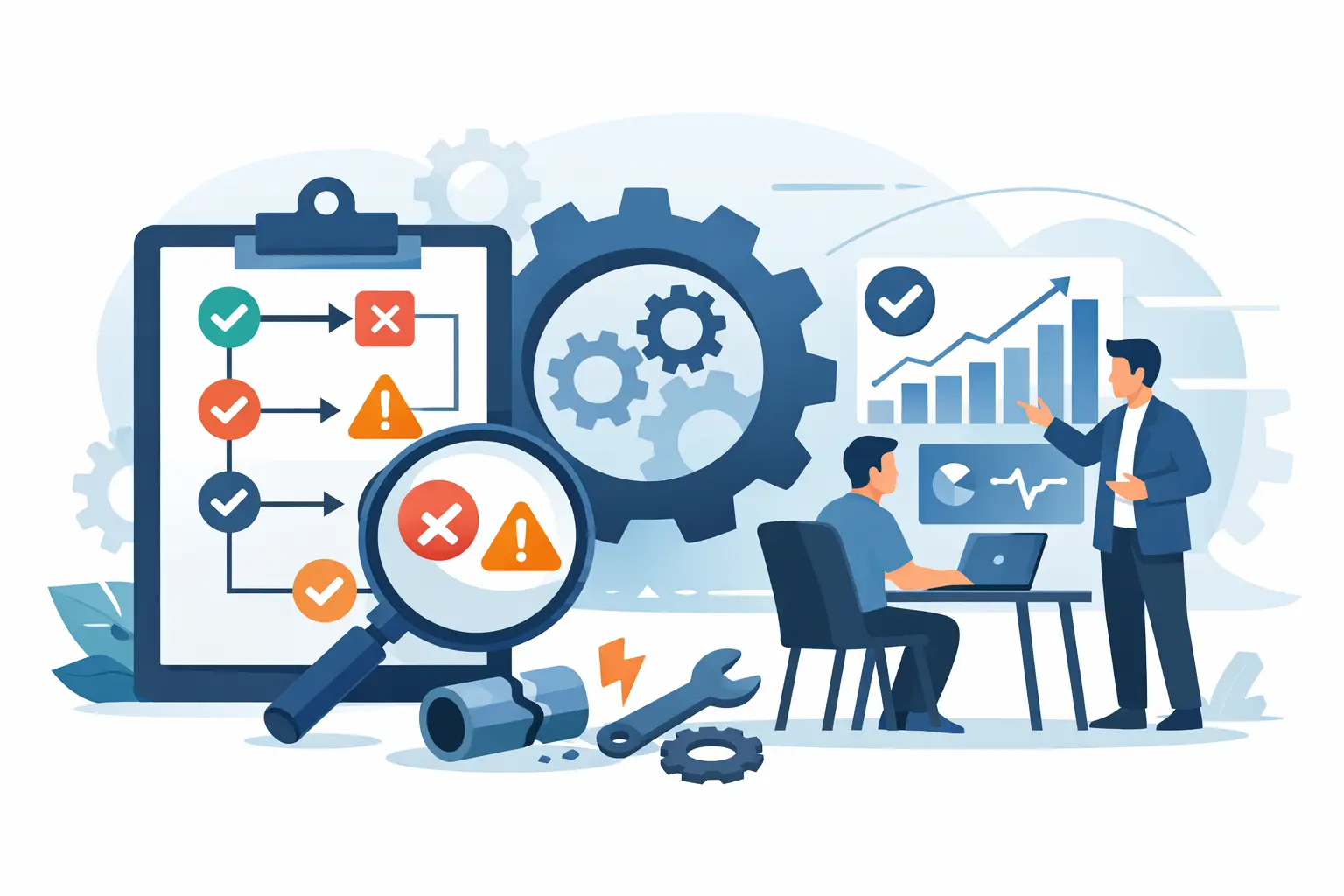
A technician closes a work order with “repair completed,” the asset returns to service, and the CMMS records another vague line of history. Multiply that across hundreds of assets, multiple shifts, and several sites, and leadership loses the ability to see what is actually failing. Knowing how to build failure codes changes that. It turns completed work orders into evidence that can guide reliability, labor planning, asset decisions, and preventive maintenance strategy.
Failure codes are not an administrative add-on. They are the language your operation uses to explain why equipment failed and what was done about it. If that language is inconsistent, overly broad, or difficult to use in the field, your reporting will be unreliable regardless of how capable your CMMS or FSM platform may be.
Start With the Decisions Your Failure Codes Must Support
The right failure-code structure depends on the decisions maintenance and operations leaders need to make. A healthcare facility may need to isolate recurring failures that affect patient care. A manufacturer may need to distinguish electrical, mechanical, controls, and material-related losses by production asset. A mechanical service contractor may need to understand repeat calls by equipment type, customer location, or installed component.
Begin with a practical question: what should leadership be able to identify from work-order history within minutes? Common answers include repeat failures by asset, the components driving downtime, recurring causes of emergency work, defects that should move into planned maintenance, and assets that are becoming candidates for replacement.
Do not begin by importing a massive generic code library. A long list may look comprehensive, but it usually creates selection errors and weak adoption. Codes that cannot support a real decision are clutter. Your goal is a controlled structure that technicians can apply accurately under real working conditions.
How to Build Failure Codes Around the Failure Story
A useful failure code system captures the failure story in a consistent sequence. In most operations, that means separating the asset or component involved, the observable problem, the likely cause, and the action taken. These fields should not be treated as duplicates.
Consider an air handler that is not maintaining discharge air temperature. The affected component may be a supply fan motor. The failure mode may be overheating. The cause could be bearing wear, restricted ventilation, voltage imbalance, or a failed overload. The corrective action may be to replace bearings, clean the motor housing, correct the electrical issue, or replace the motor.
When teams combine all of this into one free-text field, analysis becomes difficult. “Motor issue” does not tell a reliability engineer whether motors are failing, whether the real issue is poor lubrication, or whether a recurring electrical condition is damaging otherwise serviceable equipment. Separating the story gives your team data that can be filtered, trended, and acted on.
A practical model usually includes these four categories:
- Failure mode: What was wrong or what condition was observed, such as leaking, seized, overheating, shorted, misaligned, or out of calibration.
- Cause code: Why the failure occurred, such as normal wear, contamination, installation error, operator damage, electrical supply issue, or inadequate lubrication.
- Component code: The maintainable part or subsystem involved, such as belt, bearing, control board, pump seal, contactor, or sensor.
- Resolution code: What work restored the asset, such as adjusted, repaired, replaced, cleaned, rebuilt, or referred to a vendor.
Not every work order requires every field. For minor service requests, requiring a detailed cause analysis can slow technicians down and encourage guessing. For corrective work on critical assets, however, the added structure is worth it. Configure requirements based on work type, asset criticality, or downtime impact rather than applying the same rule to every ticket.
Use Language Technicians Will Actually Select
Failure codes fail when the code library is written for reports rather than for execution. Technicians should recognize the terms immediately and distinguish them without opening a reference document.
Avoid overlapping codes such as “failed,” “defective,” “bad,” and “not working.” Those options describe the same outcome at different levels of precision, so users will select based on habit. Instead, use observable conditions whenever possible. A pump can be leaking, cavitating, not starting, overheating, vibrating excessively, or delivering low flow. Those conditions point toward different diagnostic paths and different follow-up actions.
The wording should also match the workforce. If your teams consistently use “control board” instead of “printed circuit board,” use the common operational term. Standardization does not mean forcing unfamiliar terminology onto experienced technicians. It means making sure everyone uses the same term for the same condition.
Code definitions matter as much as code names. A short definition can prevent inconsistent use. For example, define “wear” as degradation expected from normal service life, while “abuse or impact damage” applies when an external event caused the condition. Without this distinction, the operation may falsely conclude that a component has a premature-life problem when equipment handling or operating practices are responsible.
Build a Hierarchy That Is Detailed, Not Burdensome
The most effective code structures allow users to start broad and select detail only when it adds value. A technician might choose an equipment class, then a component group, then a component, followed by a failure mode. This reduces the risk of selecting a code that does not apply to the asset.
However, hierarchy can become a barrier if it requires too many clicks. A technician working from a mobile device at 2 a.m. should not need to navigate five screens to close an urgent corrective work order. Keep common selections visible, use asset-specific code lists when your platform supports them, and limit required entries to the information that the organization will use.
There is also a trade-off between enterprise consistency and site-level relevance. A corporate library should standardize the core terminology across sites, especially for common asset classes and reliability reporting. But a specialized production line, central utility plant, or aviation maintenance operation may require controlled local additions. Manage those additions through governance. Do not allow each location to create its own version of “bearing failure.”
Test the Codes Against Real Work Orders
Before deploying a new structure across the organization, test it against recent closed work orders. Take a representative sample of reactive maintenance, preventive maintenance findings, emergency calls, and vendor-supported repairs. Ask experienced technicians and planners to code them using the proposed list.
This exercise exposes problems quickly. If multiple technicians interpret the same event differently, the definitions need work. If a common repair has no appropriate selection, the library has a gap. If technicians repeatedly choose “other,” either the code structure is too narrow or the workflow is asking for detail that cannot reasonably be known.
Track where users hesitate. The issue may not be the codes themselves. It may be that the work order does not capture the right asset, the asset hierarchy is unclear, or the technician is being asked to identify a root cause before troubleshooting is complete. Failure coding depends on clean asset records, disciplined work-order workflows, and enough time in the execution process to document meaningful findings.
Make Failure Coding Part of Work Management
Failure codes should be captured at the point where the knowledge is strongest: when the work is performed and reviewed. For planned corrective work, the technician records the observed mode and corrective action, while the planner or supervisor confirms cause coding when needed. For complex or high-impact failures, a reliability review may determine the root cause after a more formal investigation.
Do not confuse a cause code with a formal root cause analysis. Most work orders do not justify a full investigation. Requiring technicians to select a highly specific root cause on every job can create false precision. Use cause codes for credible, field-level explanations, then establish escalation rules for repeat, safety-related, high-cost, or downtime-intensive events.
Supervisors need a quality review process. Review a small sample of completed work orders each week for missing codes, overuse of “other,” vague descriptions, and combinations that do not make sense. A code indicating “replaced” as a failure mode, for example, signals that users do not understand the field design or the system labels are unclear.
This is accountability, not paperwork policing. When teams see their documentation lead to better parts stocking, fewer repeat failures, stronger PM tasks, and more credible capital requests, adoption improves.
Turn Failure Data Into Operational Action
A failure-code project is successful only when the data changes how work is managed. Start with a short set of recurring reports: top failure modes by critical asset class, repeat failures within a defined period, corrective labor and material cost by component, emergency work caused by common conditions, and assets with increasing failure frequency.
Use the findings to challenge assumptions. If belt failures are high, the answer may be better inspection intervals, alignment procedures, or standardized belt specifications. If control failures recur after replacement, the issue may be environmental exposure, wiring quality, voltage conditions, or an installation practice. If the same asset produces repeated corrective work, assess whether the PM program is detecting deterioration early enough or whether repair is no longer economically justified.
Keep ownership clear. Maintenance leadership should own the code standard and reporting expectations. Reliability or engineering teams should help define failure modes and escalation criteria. Planners and supervisors should maintain workflow discipline. Technicians should have a direct path to flag codes that are unclear or missing. Without ownership, code libraries decay and reporting returns to guesswork.
A well-designed failure-code structure gives your CMMS a role beyond ticket tracking. It creates a factual record of asset behavior, work execution, and recurring loss. Start with the failures that consume the most downtime, labor, and emergency attention. Build a usable standard around them, review the data regularly, and let the patterns direct the next operational improvement.